
Polski

How to Manage Sales Renewals in Zoho CRM and Stay Connected with Your Customers

In many companies, the sales process ends once the order is issued and the deal is closed. In practice, however, this is often just the beginning of an ongoing relationship with the customer—especially when we are dealing with licenses, recurring services, subscriptions, or partnerships worth revisiting after a few months.

We encountered exactly this challenge during one of our Zoho CRM implementations. The client needed a simple and effective way to ensure that sales representatives would not have to manually track renewal dates or remember when to reach out again. The goal was for the system itself to support the process and indicate when it was time to return with an offer, a reminder, or a proposal to continue cooperation.
It All Starts in the Sales Order

The starting point was the Sales Orders module. After a completed sale, we added the option to define whether a follow-up contact should be scheduled for a given order.

At the moment of finalizing the sale, the user can define:

  • how frequently the contact should recur,

  • when the next renewal should take place,

  • how many times the entire process should still be executed.

This allows future actions to be planned immediately—rather than revisiting them only when the deadline is approaching. It is a simple solution, but in practice it significantly organizes the work of the sales team.

The System Automatically Tracks the Dates

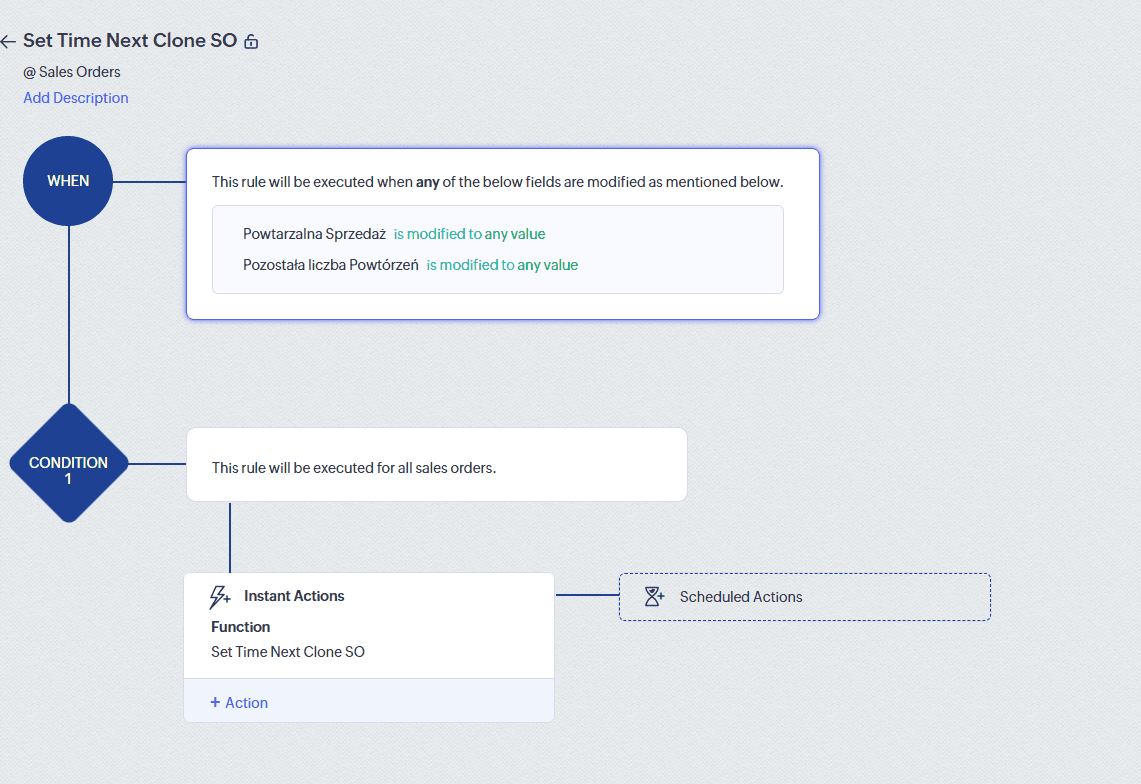
Adding fields alone was not enough, so the next step was to build automation to handle deadline tracking.

We created a workflow that automatically calculates the next renewal date whenever the settings in the Sales Order record are updated. If the user selects a monthly cycle, the system sets the next date one month ahead. If quarterly, it shifts the deadline by three months. If annual, it moves it forward by a year.

As a result, there is no need for manual calculations or external reminders. The system updates the next action date automatically and ensures nothing is overlooked. Importantly, once the planned number of repetitions reaches zero, the process ends automatically. The CRM stops generating further renewal dates, keeping everything structured and aligned with the original plan.

zoho crm sales irder wdrożenie biznes
sales order zoho crm wdrożenie

An Additional Module to Organize the Entire Process

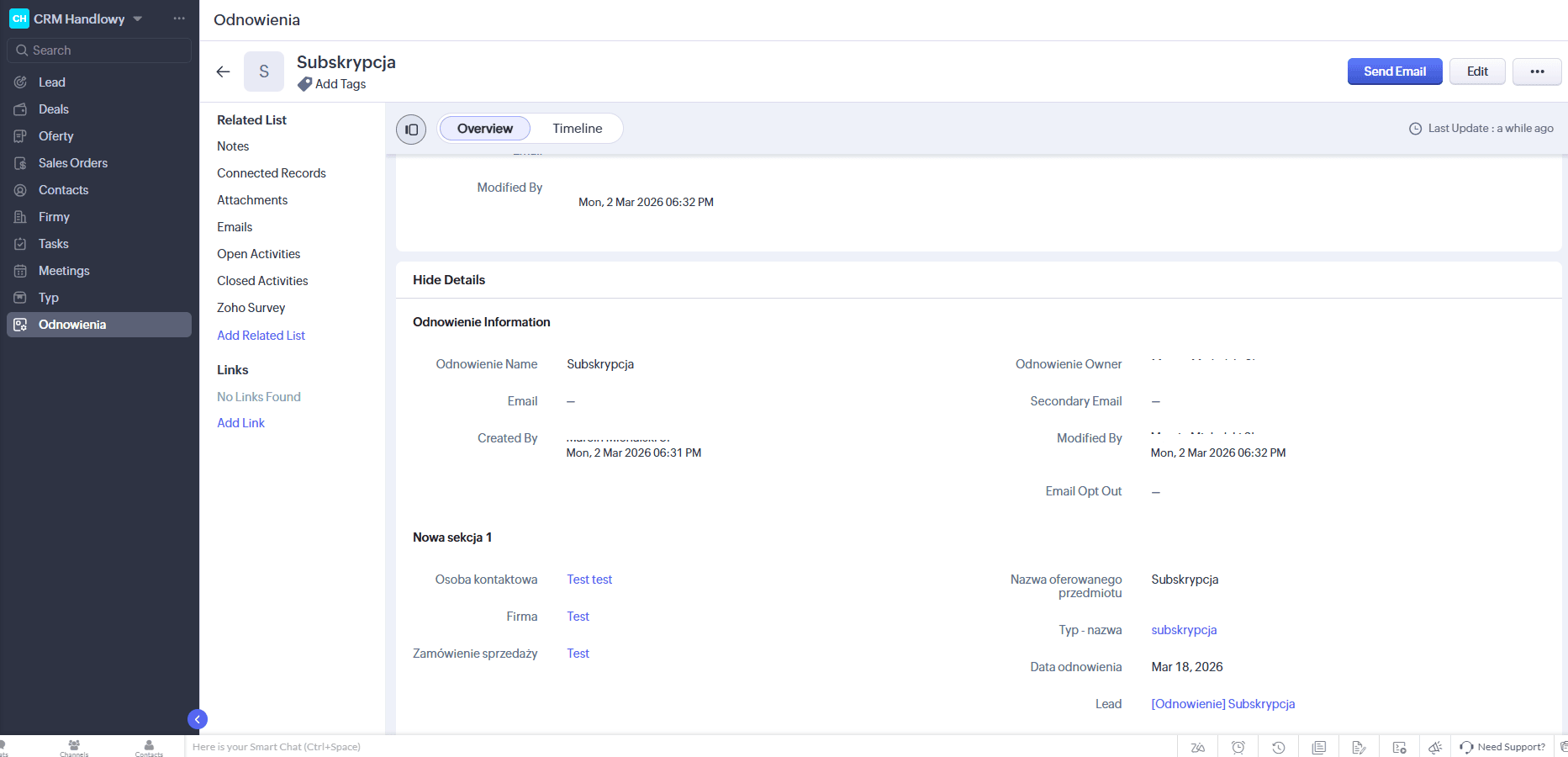
To separate completed sales from future commercial actions, we also created an additional module called Renewals.

This module stores the key information required to re-engage the customer at the right time. It acts as a bridge between a closed order and the next sales opportunity.

Thanks to this approach, the entire process becomes more transparent. Instead of returning to old records and manually reconstructing the context, the sales representative has all relevant data gathered in one place, ready to trigger further actions.

A New Lead Is Created When It Is Actually Needed

When the right moment arrives, a new Lead is automatically created from the Renewals record. It includes key information from the previous process—such as the owner, company, contact person, and a reference to the earlier sale.

This makes a significant difference. The sales representative does not have to start from scratch. They receive a ready-to-use record and can immediately take action: contact the customer, prepare a new offer, or continue discussions about extending cooperation.

In practice, this model saves time, reduces the risk of missing important deadlines, and ensures that the CRM genuinely supports the daily work of the sales team.

Zoho CRM wdrożenie proces sales insiders

What Did This Change for the Client?

The most important change was straightforward: sales representatives stopped relying solely on memory and personal reminders. Instead, they gained a structured process that proactively indicates when to reconnect with a customer.

This is particularly valuable when:

  • licenses are expiring,

  • renewal deadlines must be monitored,

  • customer relationships are recurring in nature,

  • sales do not end with a single order.

As a result, the company can operate more proactively. Instead of reacting too late, it can reach out at the right moment—before the customer starts looking for alternatives or before the opportunity is simply forgotten.

Automation That Makes Sense

Another key advantage of this solution is that it does not create unnecessary system load. Automations are triggered only when they are actually needed. There are no redundant background operations running without purpose.

This is important because a well-designed CRM process should not only be user-friendly, but also technically sound.

This implementation demonstrated that even relatively simple automation in Zoho CRM can solve a very practical business problem. By combining the Sales Orders module, a dedicated Renewals module, and automatic Lead creation, we built a process that ensures customers are re-engaged at the right time.

And that is what a well-designed CRM should do—not only record sales, but also support future actions and help build long-term customer relationships.