


The CRM market is increasingly moving toward AI-supported systems. It is no longer only about storing customer, lead, and opportunity data. Modern CRM platforms are expected to help sales teams qualify leads, manage opportunities, forecast results, analyze the pipeline, and decide on next steps. In the Magic Quadrant for CRM Sales Platforms report published on August 6, 2026, Gartner describes CRM sales platforms as AI-driven systems that support end-to-end sales workflows and increase the productivity of sales representatives and managers.
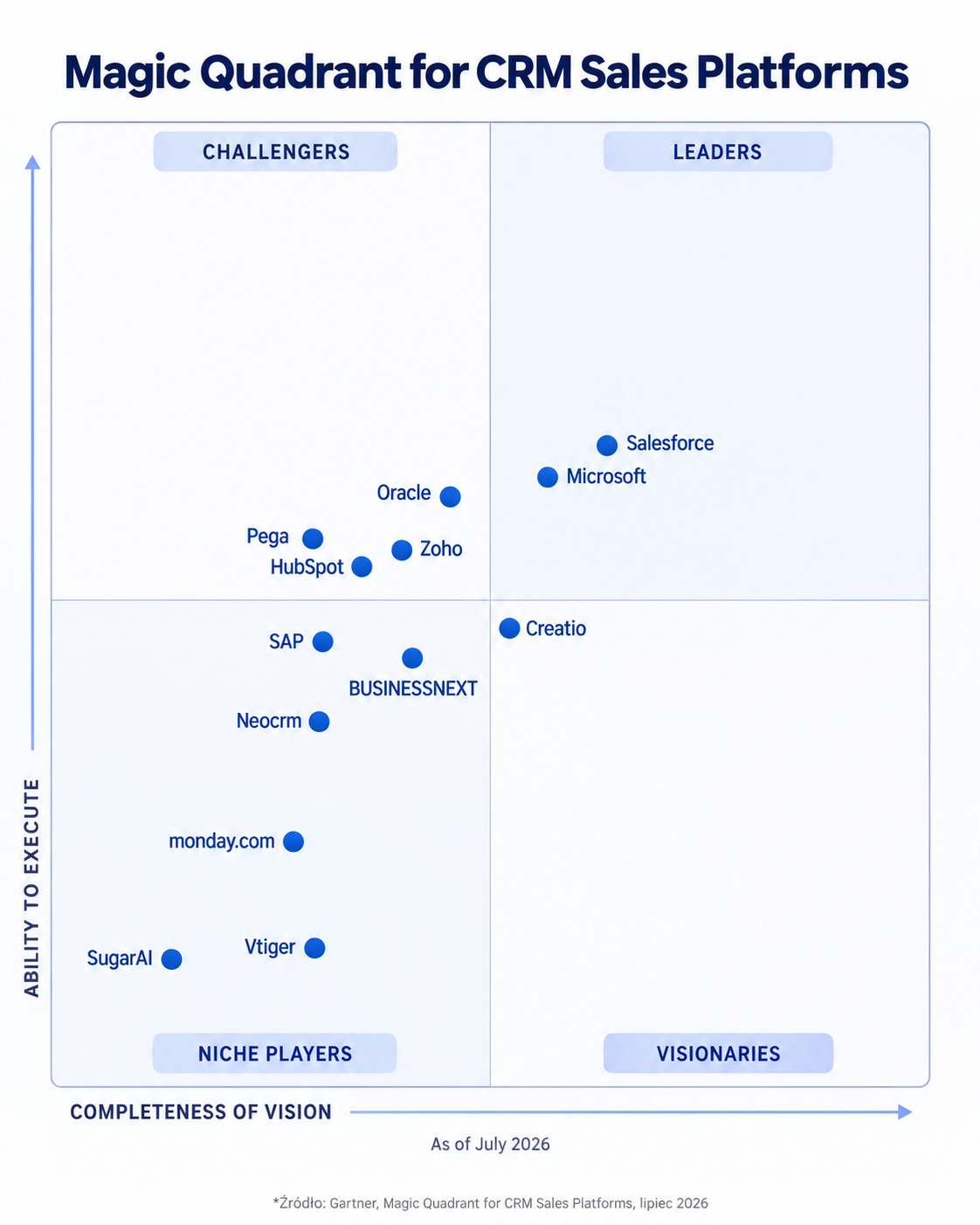
In this year’s report, Zoho was classified as a Challenger. HubSpot, Oracle, and Pega were also placed in the same quadrant, while Gartner named Microsoft and Salesforce as Leaders. Creatio was positioned as a Visionary, and other providers, including SAP, SugarAI, Vtiger, monday.com, and BUSINESSNEXT, were categorized as Niche Players.
For companies considering a CRM implementation or a system change, Zoho’s position is important for several reasons. Gartner indicates that Zoho CRM is mainly focused on small, midsize, and upper-midsize organizations that need broad CRM capabilities, a unified AI layer through Zia, and a large ecosystem of business applications. The report also highlights Zoho’s global reach across North America, LATAM, EMEA, and APAC, with particularly strong coverage in APAC and emerging markets.
Zoho CRM as a Challenger. What does it mean?
The Challengers category includes vendors that have scale, recognition, and the ability to compete globally, but are not always assessed as market direction-setters to the same extent as Leaders. Gartner describes Challengers as companies that understand the evolving needs of sales organizations, although they may not always lead customers into new functional areas with an equally strong product vision.
In Zoho’s case, this position reflects the character of the platform well. Zoho CRM is not limited to sales alone. It is part of a broader application ecosystem, which matters for companies that want to connect CRM with marketing, customer service, analytics, automation, and other business processes.
The key strengths of Zoho CRM according to the report
One of the most important elements highlighted by Gartner is the unified Zia experience. Zia acts as the intelligence layer in Zoho CRM, combining predictive scoring, summaries, and assistant-driven workflows within a single interface. For sales teams, this means one access point for AI capabilities, without the need to move between multiple disconnected modules.
The second area highlighted is Zia Agent Studio. According to the report, it enables the management of knowledge sources, model selection, and multi-agent orchestration. Gartner also points to administrative tools related to agent observability and action tracing, which can be especially important for organizations that want to use AI in sales while maintaining control over how agents operate.
The third strength is broad geographic coverage. Zoho offers various data residency options, localized interfaces, and an extensive regional partner network. This is important for companies operating across multiple countries or those that need local support during implementation and system development.
How does Zoho compare with other providers?
Compared with market Leaders such as Microsoft and Salesforce, Zoho is positioned differently. Microsoft is described as a vendor strongly embedded in the Dynamics 365, Outlook, Teams, Copilot, and Dataverse environment, with an emphasis on integrating sales into everyday productivity tools. Salesforce, on the other hand, is presented as a platform with broad capabilities across AI, sales engagement, forecasting, data, analytics, and agent building.
HubSpot, which is also positioned as a Challenger, is described in the report as being strongly focused on seller adoption, sales engagement, and RevOps workflows for small and midsize organizations. Gartner highlights its ease of use, fast deployment, and integrated marketing and sales workflows.
Against this background, Zoho stands out primarily through the combination of CRM, AI, and a broader application ecosystem. For companies that do not want to build their sales environment on multiple separate tools, but are looking for a platform that can be developed across different areas of the business, this may be particularly relevant.
The CRM market in 2026: AI is changing how platforms are evaluated
The report also shows a broader trend. The CRM sales platforms market grew by 12.1% in 2025, reaching $16.9 billion. Gartner also notes a clear increase in interest around AI capabilities and where companies should anchor their sales platform investments.
This matters because choosing a CRM in 2026 is increasingly less about comparing feature lists alone. Data quality, the way AI works, integration availability, the cost of using AI features, agent management capabilities, and whether the system truly supports the daily work of sales teams are becoming equally important. Gartner emphasizes that the practical value of AI depends not only on feature availability, but also on packaging, data readiness, and usage economics.
What does Zoho CRM’s position mean for companies considering implementation?
Zoho’s position as a Challenger shows that it is a platform with a strong presence in the CRM sales platforms market and a clear development direction toward AI, agents, and broader sales automation. Its main advantage is the combination of CRM, Zia, Agent Studio, and the Zoho application ecosystem, which may be especially attractive for companies that want to develop sales, marketing, analytics, and customer service in one coherent environment.
At the same time, the report clearly shows that before choosing a CRM, companies should test specific processes rather than only compare vendor claims. In Zoho’s case, it will be especially important to verify AI scenarios, mobile work, dependencies on other applications, and how well the system fits the needs of the sales team.
For organizations looking for a flexible CRM with a broad ecosystem and a developing AI layer, Zoho CRM remains a solution worth considering.


For 6 years, he has been involved in B2B sales and customer service. He specializes in building long-term business relationships, managing sales processes from the first contact through to closing, working with CRM systems, and optimizing sales activities. He combines an analytical approach to performance with strong communication skills. Focused on effectiveness, proactivity, and providing real support for client growth, he thrives in a dynamic sales environment where both strategy and execution matter. When sales need to deliver concrete results, Kamil knows how to lead the process.
Kamil Szymański, Business Development Specialist